Now also available on Amazon.
READING THE BIBLE INSIDE A JEEPNEY: Celebrating Colonized and Occupied Peoples' capacity to beat swords into plowshares; to transform weapons of mass destruction into instruments of mass celebration; mortar shells into church bells, teargas canisters to flowerpots; rifle barrels into flutes; U.S. Military Army Jeeps into Filipino Mass Transport Jeepneys.
Tuesday, January 14, 2025
Thursday, January 09, 2025
CROSSING THE JORDAN AND TAKING SIDES
We know what we are supposed to do: help change the world. But before we even think of changing the world, we need the world to change us.Thus, integration with communities--immersion into different ways of life--is a prerequisite. The late Fr. Carlos Abesamis, in conversation, said that having the Bible in one hand and a newspaper in the other is not enough. Newspapers will never be a substitute for immersion, nor will television, radio, or social media.
Immersion transforms people! Immersion has done so for many of us! In the fullness of time, even God went on Immersion. We call it incarnation. Immersion changed God.
Sunday's lection reminds us that one of the most powerful images of immersion in the Bible is baptism. Baptism is about taking sides. When John baptized people in the Jordan, they crossed from one bank to the other, from one side to the other side. They re-enacted the crossing of the Jordan.
It is about doing what Ernesto "Che" Guevarra did: swimming from one bank to the other bank of the Amazon River, knowingly putting himself at risk of a deadly asthma attack and drowning, yet choosing the side of those whose only hope was God.
Baptism is crossing the Jordan: choosing justice and taking possession of liberty, land, and fullness of life that God wants for all people, especially for occupied peoples. Crossing the Jordan can lead to death. John the Baptist crossed the Jordan and was executed by Herod. Jesus crossed the Jordan and was crucified by the Romans.
And you and I are called by our baptism to cross "Rivers of Jordan" wherever we are. Every moment of our lives, we need to choose justice. May we have the courage to do as John and Jesus did.
Choose justice. Always justice.
*art, "John baptizing Jesus," Mural at the Church of Enda Yesus, Axum, Ethiopia (image available at the vanderbilt divinity library digital archives).
Monday, January 06, 2025
READING THE PARABLES OF JESUS INSIDE A JEEPNEY
Thursday, January 02, 2025
GOD IS ONE OF US
The Canonical Gospels begin their narratives in different ways. Mark begins with an adult Jesus who is baptized by John in the Jordan. Matthew has a birth narrative that features Magi who spent about two years searching for the child. Jesus was already a toddler when they reach Bethlehem. Luke's has shepherds who visit Jesus as a baby lying in a manger. John's origin story, which is Sunday's lection, begins in "The Beginning."
Incidentally, a lot of people who memorize Bible verses know John 1.1 (with Genesis 1.1 and, almost everyone's favorite, John 3.16). The Word became Flesh and lived among us. God has stopped watching from a distance.
Stories of Gods taking on human form abound in many of the world's mythologies. Many of the heroes of ancient peoples were demigods or super humans. For the Gospel of John, when the Word became Flesh, the Word was totally and fully Flesh. In other words, God was not Superman disguised as Clark Kent. God was Clark Kent.
For the Gospel of John, God Incarnate gets tired and thirsty; eats and drinks with family and friends; experiences love and loss, and cries, like all of us. God Incarnate takes the side of the poor, feeds the multitudes, experiences betrayal, and suffers torture and crucifixion by empire. Like many among us.
God bleeds. God dies. God is one of us.
My Friends, to believe in the incarnation is to embody justice, accompaniment, solidarity, and life-giving, like Jesus did. The incarnation required a warm body: Jesus’s. The incarnation still requires warm bodies: yours and mine.
*"Christ Child" by Mike Chapman (relief sculpture at Westminster, London), photograh by Diane Brennan. Vanderbilt Divinity Library image collection.
Thursday, December 26, 2024
TURNING POINTS
The Temple in Jerusalem plays an important role in Luke. The gospel begins with Zachariah in the Temple. It ends with the disciples in the Temple. Sunday's reading is about Jesus, aged 12, in the Temple. Those of us who grew up in Sunday School are familiar with the story.I'm pretty sure that most of us have memorable experiences when we were 12 or thereabouts. I'm also sure that there were moments when our parents or elders were at their wits' end trying to find out where we've gone. For many among us, those winged moments served as turning points in our lives.
Jesus was gone for four days in the story. Mary and Joseph spent 3 anxiety-laden days looking for him.
They find him in the Temple and when asked to explain he tells them, "Why were you searching for me? Did you not know that I must be in my Father's house?" Mary and Joseph then realize that Jesus is not just their first born. He is more than that. He has ceased being a boy. Things will never be the same again. They've reached a turning point.
Sure, he comes home to Nazareth with them but things have changed. Things will never be the same again.
Jesus was gone for four days in the story. Mary and Joseph spent 3 anxiety-laden days looking for him.
They find him in the Temple and when asked to explain he tells them, "Why were you searching for me? Did you not know that I must be in my Father's house?" Mary and Joseph then realize that Jesus is not just their first born. He is more than that. He has ceased being a boy. Things will never be the same again. They've reached a turning point.
Sure, he comes home to Nazareth with them but things have changed. Things will never be the same again.
*art, "Jesus among the Teacher," JESUS MAFA, 1973, Cameroon (available at the vanderbilt divinity libray digital archives)
Thursday, December 19, 2024
THE SONG OF MARY
Mary's Magnificat is probably one of the most powerful prophetic passages in the New Testament. This young woman's God scatters the proud in the thoughts of their hearts, brings down the powerful from their thrones and lifts up the lowly, fills the hungry with good things, and sends the rich away empty. Melinda Grace Aoanan reminds us-- via her radical rendition of "Ili, ili" that is based on the Magnificat-- that the latter was a song. It was a lullaby Mary sang or chanted for Jesus.
This young woman from Nazareth followed a God who took sides, a God who took the preferential option for the poor, a God who brought down kings and kingdoms, a God who wept with those who weep and who cried with those who cry. And she taught her son well. Very well indeed.
Mary's faith persists to this day. Yet the proud, the powerful, and the rich who pretend to venerate her fail to see this faith among the lowly and the hungry as they struggle against life-negating and death-dealing forces-- among those whose lives are dedicated to helping bring about peace based on justice and the realization of God's reign on earth.
Moreover, the proud, the powerful, and the rich who pretend to venerate her tag so many of the faithful who are working for "life in all its fullness" as enemies of the state or as communists, as if communism were a crime in the country. It is not. Worse, they criminalize dissent and illegally arrest so many on trumped up charges like murder and illegal possession of firearms and explosives.
Jesus had many teachers. But before everyone else, there was young Mary of Nazareth: The Prophet who sang. His mother. And she taught her son well. Very well indeed.
+Melinda Grace Aoanan, "Singing Our Magnificat..." in Pinay Magnificat: Living Out Our Theology (Quezon City: NCCP, 2017), 23-31.
*image "The Visitation--Mary and Elizabeth meet." JESUS MAFA (Vanderbilt Divinity Library digital archives)
This young woman from Nazareth followed a God who took sides, a God who took the preferential option for the poor, a God who brought down kings and kingdoms, a God who wept with those who weep and who cried with those who cry. And she taught her son well. Very well indeed.
Mary's faith persists to this day. Yet the proud, the powerful, and the rich who pretend to venerate her fail to see this faith among the lowly and the hungry as they struggle against life-negating and death-dealing forces-- among those whose lives are dedicated to helping bring about peace based on justice and the realization of God's reign on earth.
Moreover, the proud, the powerful, and the rich who pretend to venerate her tag so many of the faithful who are working for "life in all its fullness" as enemies of the state or as communists, as if communism were a crime in the country. It is not. Worse, they criminalize dissent and illegally arrest so many on trumped up charges like murder and illegal possession of firearms and explosives.
Jesus had many teachers. But before everyone else, there was young Mary of Nazareth: The Prophet who sang. His mother. And she taught her son well. Very well indeed.
+Melinda Grace Aoanan, "Singing Our Magnificat..." in Pinay Magnificat: Living Out Our Theology (Quezon City: NCCP, 2017), 23-31.
*image "The Visitation--Mary and Elizabeth meet." JESUS MAFA (Vanderbilt Divinity Library digital archives)
Thursday, December 12, 2024
ABRAHAM'S CHILDREN
All the canonical gospels feature John the Baptist. But most scholars agree that Sunday's Lukan lection comes from "Q" (short for "quelle" meaning, source)."Q" is theorized as an earlier collection of Jesus tradition that was only accessible to Matthew and Luke.
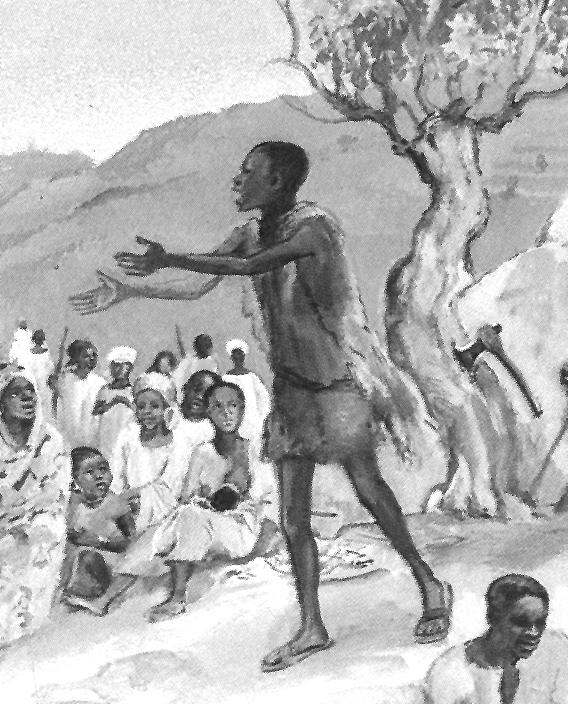
John, like the prophets before him, did not pull punches. He calls everyone to repentance, to change direction, and to follow God's way of justice.
My favorite part of the passage is how John addresses those who think they do not need to repent or change their ways because they are God's "Chosen", that they are God's favorites. John basically tells them, "God can make Abraham's children out of a pile of stones." (John's retort resonates with Jesus' "stones crying out" response to some religious leaders in Jerusalem).
John's message remains relevant and powerful today, especially to us who think we're "Chosen". We need to repent. And repentance means doing, not thinking, nor praying: specifically, it's doing acts of justice. Or we face God's wrath.
We all need to repent! God can still make Abraham's children out of a pile of stones.
*image, "John the Baptist preaching in the desert," JESUS MAFA, 1973, Cameroon, from the vanderbilt divinity library digital archives.
Thursday, December 05, 2024
PREPARE YE THE WAY OF THE LORD
Ancient Israelite tradition expected the prophet Elijah to return and prepare the way for the Messiah. Christianity believes that Jesus of Nazareth is the Messiah and, thus, his forerunner, his "Elijah" is John the Baptist.
Sunday's lection tells us that the word of God came to John in the wilderness. Not in Jerusalem, not inside Herod's temple, not even in a synagogue, nor through the Saducees, Pharisees, and Scribes.
The wilderness conjures up a lot of ambivalent images for us who study scripture. God appeared to a hardheaded Moses through the burning bush in the wilderness. The Israelites wandered almost aimlessly in the wilderness for forty long years. Many of them died there, including Moses. Like John, the wilderness played a key role in Jesus' early ministry. The wilderness does not seem like a very hospitable place.
Yet, many times, God reveals Godself in the wilderness-- in spaces and places we don't expect God to be.
God anointed John to prepare people for a new way: not the way of Emperor Tiberius, Herod, his brother Philip, Pontius Pilate, Annas, Caiaphas, and their ilk. But God's way that "will make every valley filled, and every mountain and hill made low, and the crooked made straight, and the rough ways made smooth; and all flesh see God's salvation."
And God's way requires repentance: a complete turnaround; a 180; a change in the opposite direction; deciding to stop pretending but actually living our lives loving God by serving people, especially those whose only hope is God.
*art, "John the Baptist preaching in the desert," (JESUS MAFA 1973), available at the vanderbilt divinity library digital archives.
Sunday's lection tells us that the word of God came to John in the wilderness. Not in Jerusalem, not inside Herod's temple, not even in a synagogue, nor through the Saducees, Pharisees, and Scribes.
The wilderness conjures up a lot of ambivalent images for us who study scripture. God appeared to a hardheaded Moses through the burning bush in the wilderness. The Israelites wandered almost aimlessly in the wilderness for forty long years. Many of them died there, including Moses. Like John, the wilderness played a key role in Jesus' early ministry. The wilderness does not seem like a very hospitable place.
Yet, many times, God reveals Godself in the wilderness-- in spaces and places we don't expect God to be.
God anointed John to prepare people for a new way: not the way of Emperor Tiberius, Herod, his brother Philip, Pontius Pilate, Annas, Caiaphas, and their ilk. But God's way that "will make every valley filled, and every mountain and hill made low, and the crooked made straight, and the rough ways made smooth; and all flesh see God's salvation."
And God's way requires repentance: a complete turnaround; a 180; a change in the opposite direction; deciding to stop pretending but actually living our lives loving God by serving people, especially those whose only hope is God.
*art, "John the Baptist preaching in the desert," (JESUS MAFA 1973), available at the vanderbilt divinity library digital archives.
Thursday, November 28, 2024
THE END OF DAYS
The Season of Advent has begun and we expect a Christmas-related reading.
Sunday's Lukan lection is about the Apocalypse. We also find this passage in Mark and Matthew and many scholars call it the "mini-apocalypse." They agree that the passage reflects traumatic memories from the Fall of Jerusalem around 70 CE.
A lot of people look forward to the End of Days or the Second Coming because it promises eternal rewards and punishment. Of course, there are millions of card-carrying Christians who expect that they will be rewarded, while so-called infidels-- namely, anyone who has not accepted Jesus as their Personal Savior and Lord-- will be punished.
Many others look forward to the day that God will make things right, especially for those who have been dispossessed, displaced, disenfranchised, discriminated, and dehumanized by greed, injustice, and evil.
There are also those who dread the End of Days or the Second Coming because they know they have failed to do what Jesus, in his First Coming, commanded them to do: preach Good News to the Poor, feed the hungry, give drink to the thirsty, take care of the sick, visit the prisoners, clothe the naked, and welcome the stranger.
The day will come. Nobody knows which day or which hour, but it will happen. Thus, the lesson of the fig tree. We must be patient. You don't plant figs today and expect fruits tomorrow. We must study the signs. Have the leaves changed color? Are flowers in bloom. We must be discerning. Friends, the day will surely come. Jesus said so.
So, we wait. We study the signs. And, every moment, try our very best to follow the life that Jesus lived.
The end might come today.
*art, "The Last Judgment" by Peter Paul Rubens, 1577-1640 (available from the vanderbilt divinity library digital art collection).
Sunday's Lukan lection is about the Apocalypse. We also find this passage in Mark and Matthew and many scholars call it the "mini-apocalypse." They agree that the passage reflects traumatic memories from the Fall of Jerusalem around 70 CE.
A lot of people look forward to the End of Days or the Second Coming because it promises eternal rewards and punishment. Of course, there are millions of card-carrying Christians who expect that they will be rewarded, while so-called infidels-- namely, anyone who has not accepted Jesus as their Personal Savior and Lord-- will be punished.
Many others look forward to the day that God will make things right, especially for those who have been dispossessed, displaced, disenfranchised, discriminated, and dehumanized by greed, injustice, and evil.
There are also those who dread the End of Days or the Second Coming because they know they have failed to do what Jesus, in his First Coming, commanded them to do: preach Good News to the Poor, feed the hungry, give drink to the thirsty, take care of the sick, visit the prisoners, clothe the naked, and welcome the stranger.
The day will come. Nobody knows which day or which hour, but it will happen. Thus, the lesson of the fig tree. We must be patient. You don't plant figs today and expect fruits tomorrow. We must study the signs. Have the leaves changed color? Are flowers in bloom. We must be discerning. Friends, the day will surely come. Jesus said so.
So, we wait. We study the signs. And, every moment, try our very best to follow the life that Jesus lived.
The end might come today.
*art, "The Last Judgment" by Peter Paul Rubens, 1577-1640 (available from the vanderbilt divinity library digital art collection).
Thursday, November 21, 2024
KINGS AND THEIR KINGDOMS
The Romans executed Jesus as a messianic claimant, as an enemy of the state, as a rebel. Josephus and Tacitus both wrote that he was crucified by order of Pontius Pilate.
In a world where Caesar is Lord, sin is legislated, resistance is criminalized, and dissent is demonized. The merger of political and religious power predates Pontius Pilate's and Joseph Caiaphas's conjugal dictatorship.
If we read our Bibles and pray everyday, we will grow, grow, grow in this realization: sinners are, more often than not, synonymous with the poor, oppressed, and marginalized in the Gospels. Who can afford the offerings in the temple? Who has the resources to bribe authorities? Who writes the law and for whose benefit?
Nothing has changed. The political and religious elites' culture of impunity continues to crush the poor underfoot.
Sunday's lection features a conversation between symbols of two completely opposite gospels: Rome's and God's; the Good News for the Rich and the Good News for the Poor. Both talk about kings and kingdoms, but totally opposite kings and kingdoms.
Tragically, so many among us confess "Jesus is Lord," but in word, thought, and deed, we side with Pilate's Lord. Our lust for power, prestige, and privilege, our envy for the powerful, prestigious, and privileged paint lives that scream, "Caesar is Lord".
In a world where Caesar is Lord, sin is legislated, resistance is criminalized, and dissent is demonized. The merger of political and religious power predates Pontius Pilate's and Joseph Caiaphas's conjugal dictatorship.
If we read our Bibles and pray everyday, we will grow, grow, grow in this realization: sinners are, more often than not, synonymous with the poor, oppressed, and marginalized in the Gospels. Who can afford the offerings in the temple? Who has the resources to bribe authorities? Who writes the law and for whose benefit?
Nothing has changed. The political and religious elites' culture of impunity continues to crush the poor underfoot.
Sunday's lection features a conversation between symbols of two completely opposite gospels: Rome's and God's; the Good News for the Rich and the Good News for the Poor. Both talk about kings and kingdoms, but totally opposite kings and kingdoms.
Tragically, so many among us confess "Jesus is Lord," but in word, thought, and deed, we side with Pilate's Lord. Our lust for power, prestige, and privilege, our envy for the powerful, prestigious, and privileged paint lives that scream, "Caesar is Lord".
*art, "What is Truth?", by Ge, N. N. (Nikolaĭ Nikolaevich), 1831-1894, available from the vanderbilt divinity library digital collection.
Thursday, November 14, 2024
THE CHURCH IS NOT A BUILDING...
Sunday's lection reminds us of Herod the Great's Temple that, according to Jesus, was built from the offerings of widows and other very poor people.
Jesus said, "Not one stone will be left here upon another; all will be thrown down!" And he was right.
We are uncomfortable with a Jesus who speaks of doom, destruction, and death. We do not wish to see Jesus brandishing a whip while driving out those who were selling and buying in the Temple, including the moneychangers. We do not want to acknowledge that Jesus can be angry--and violently angry, at that.
We are so used to the Jesus we have created in our image. We are so used to the huge cathedrals and grand buildings we have created to make us comfortable when we come together in his name. We have even come up with the phrase "Sunday best", air conditioning, and exclusive seating inside these walls we have built as imposing monuments of our faith in God. Remember Jesus’s words, "Not one stone will be left here upon another; all will be thrown down."
Friends, our comforts have made us forget that the church is not a building. It never was. It never will be. It has always been people: people who love; people who serve; people who offer their lives so that others may live, like Jesus did.
And when the church ceases to serve its purpose, we should not be surprised when Jesus himself tears it down.
Jesus said, "Not one stone will be left here upon another; all will be thrown down!" And he was right.
We are uncomfortable with a Jesus who speaks of doom, destruction, and death. We do not wish to see Jesus brandishing a whip while driving out those who were selling and buying in the Temple, including the moneychangers. We do not want to acknowledge that Jesus can be angry--and violently angry, at that.
We are so used to the Jesus we have created in our image. We are so used to the huge cathedrals and grand buildings we have created to make us comfortable when we come together in his name. We have even come up with the phrase "Sunday best", air conditioning, and exclusive seating inside these walls we have built as imposing monuments of our faith in God. Remember Jesus’s words, "Not one stone will be left here upon another; all will be thrown down."
Friends, our comforts have made us forget that the church is not a building. It never was. It never will be. It has always been people: people who love; people who serve; people who offer their lives so that others may live, like Jesus did.
And when the church ceases to serve its purpose, we should not be surprised when Jesus himself tears it down.
*photo, The Western or "Wailing Wall" in the Old City of Jerusalem (taken last 9 August 2016).
Thursday, November 07, 2024
LIVING OFF THE BACKS OF THE POOR
We grew up hearing sermons on stewardship based on Sunday's lection from Mark 12 (which is also found in Luke 21). Jesus said, "This poor widow has put in more than all those who are contributing to the treasury. For all of them have contributed out of their abundance but she, out of her poverty, has put in all that she had to live on.”
We grew up being taught to be cheerful givers, like the poor widow, and offer everything we have to live on to the Lord and the Lord's work. Not just our food, money, and house; even our mental and emotional health is given away for God's sake.
Thank God, most of us have outgrown these teachings. Now, we are learning to follow the One whose life and ministry was dedicated to widows, orphans, and strangers, the One who preached a Gospel for the Poor, the One who offered his life so that others may live.
Now, we are learning how many institutionalized structures and systems--religious or otherwise--rob people of even the barest that they have. Now, we realize that Jesus was actually denouncing the temple elite's unjust system of dispossessing the already dispossessed in the name of God. I think the incident at the temple was one of his ways of declaring, “Enough! This temple has become a den of thieves!”
Yet, many of our churches and our programs continue to thrive and live off of the backs of the poor and suffering.
Friends, don't forget this, ever: Jesus condemns the scribes who devour widows' houses. Moreover--if you read his precise words--Jesus does not tell us to "go and do" as the widow did.
We grew up being taught to be cheerful givers, like the poor widow, and offer everything we have to live on to the Lord and the Lord's work. Not just our food, money, and house; even our mental and emotional health is given away for God's sake.
Thank God, most of us have outgrown these teachings. Now, we are learning to follow the One whose life and ministry was dedicated to widows, orphans, and strangers, the One who preached a Gospel for the Poor, the One who offered his life so that others may live.
Now, we are learning how many institutionalized structures and systems--religious or otherwise--rob people of even the barest that they have. Now, we realize that Jesus was actually denouncing the temple elite's unjust system of dispossessing the already dispossessed in the name of God. I think the incident at the temple was one of his ways of declaring, “Enough! This temple has become a den of thieves!”
Yet, many of our churches and our programs continue to thrive and live off of the backs of the poor and suffering.
Friends, don't forget this, ever: Jesus condemns the scribes who devour widows' houses. Moreover--if you read his precise words--Jesus does not tell us to "go and do" as the widow did.
*art, "The Widow's Mite," JESUS MAFA 1973 (available at vanderbilt divinity library digital archives).
Subscribe to:
Comments (Atom)

.jpg)


.png)