READING THE BIBLE INSIDE A JEEPNEY: Celebrating Colonized and Occupied Peoples' capacity to beat swords into plowshares; to transform weapons of mass destruction into instruments of mass celebration; mortar shells into church bells, teargas canisters to flowerpots; rifle barrels into flutes; U.S. Military Army Jeeps into Filipino Mass Transport Jeepneys.
Monday, February 10, 2025
Thursday, February 06, 2025
GO FISH!
When we were growing up, we used to sing a song in Sunday School that went, "I will make you fishers of men, fishers of men, fishers of men. I will make you fishers of men if you follow me."
Life during the time of Jesus was extremely difficult. Historians paint a Roman-occupied Palestine where the average life expectancy was under 30, the majority was suffocating in debt, and half of the population was slowly starving to death.
At the bottom of the social structure were farmers and fisherfolk. Nothing has changed. Farmers and fisherfolk remain at the bottom of the social structure today. Over 1.5 million families in the Philippines are fisherfolk. The poorest two out of every five poor people in the country are fisherfolk.
In Sunday's Gospel Reading Jesus calls fisherfolk to follow him in order to fish for people. A carpenter calls fisherfolk to fish. Jesus does not call anyone to worship him. Or to believe in him. Or to accept him as their Personal Savior and Lord. Or even to be a carpenter. Jesus calls us to follow him. To do what? To fish for people.
Many ancient peoples were afraid of the seas. They feared drowning; they feared the turbulent waves; they feared the ancient, eldritch leviathans they imagined lurking beneath the surface.
But Jesus does not call us to fish people out of their fear of the deep.
During Jesus's time, the Empire owned and controlled the seas! Taxes were imposed on fishing, on boats, on nets, on everything! In our lection, Simon tells Jesus that they were fishing all night and caught nothing.
Jesus's call to fish for people is a call for us to follow him in taking out people from systems and structures that oppress, that dehumanize, that subjugate, that murder.
And who are the people who experience the evil of these systems and structures every single moment of their lives? Fisherfolk. Genuine transformation always comes from below, from among those at greatest risk of drowning, from the toiling masses, from among those whose only hope is God. The call has not changed. People, especially the most vulnerable, are drowning in imperial waters. Trump back as POTUS makes things worse.
Jesus is calling us right now to follow him and fish for people.
*Art, "Miracle Catch" by Mike Moyers. To purchase Moyer's works, please visit mikemoyersfineartdotcom. Image accessed from vanderbilt divinity library digital archives.
Life during the time of Jesus was extremely difficult. Historians paint a Roman-occupied Palestine where the average life expectancy was under 30, the majority was suffocating in debt, and half of the population was slowly starving to death.
At the bottom of the social structure were farmers and fisherfolk. Nothing has changed. Farmers and fisherfolk remain at the bottom of the social structure today. Over 1.5 million families in the Philippines are fisherfolk. The poorest two out of every five poor people in the country are fisherfolk.
In Sunday's Gospel Reading Jesus calls fisherfolk to follow him in order to fish for people. A carpenter calls fisherfolk to fish. Jesus does not call anyone to worship him. Or to believe in him. Or to accept him as their Personal Savior and Lord. Or even to be a carpenter. Jesus calls us to follow him. To do what? To fish for people.
Many ancient peoples were afraid of the seas. They feared drowning; they feared the turbulent waves; they feared the ancient, eldritch leviathans they imagined lurking beneath the surface.
But Jesus does not call us to fish people out of their fear of the deep.
During Jesus's time, the Empire owned and controlled the seas! Taxes were imposed on fishing, on boats, on nets, on everything! In our lection, Simon tells Jesus that they were fishing all night and caught nothing.
Jesus's call to fish for people is a call for us to follow him in taking out people from systems and structures that oppress, that dehumanize, that subjugate, that murder.
And who are the people who experience the evil of these systems and structures every single moment of their lives? Fisherfolk. Genuine transformation always comes from below, from among those at greatest risk of drowning, from the toiling masses, from among those whose only hope is God. The call has not changed. People, especially the most vulnerable, are drowning in imperial waters. Trump back as POTUS makes things worse.
Jesus is calling us right now to follow him and fish for people.
*Art, "Miracle Catch" by Mike Moyers. To purchase Moyer's works, please visit mikemoyersfineartdotcom. Image accessed from vanderbilt divinity library digital archives.
Wednesday, February 05, 2025
IN MEMORY OF ONESIMUS
Live on Amazon now: https://a.co/d/gtFSirL
IN MEMORY OF ONESIMUS:
Reading Philemon inside a Jeepney
Reading Philemon inside a Jeepney involves privileging Onesimus. Not Paul. Nor Philemon. Paul describes Onesimus as useless in the epistle. But “useless” is a relative term. The tens of thousands of rusted military jeeps the US Army thought useless at the end of World War II in the Philippines, Filipinos found useful as raw materials for what was to become the most popular mode of mass transportation in the islands, the jeepney...
Monday, February 03, 2025
CELEBRATING THE BIBLE, DIVERSITY, EQUITY, AND INCLUSION
How Many Squares Do You See? https://a.co/d/iwqqRqu
The Shortest Short Introduction to the Bible https://a.co/d/1NJEoYO
The Shortest Short Introduction to Biblical Interpretation https://a.co/d/0zvhFB2
The Shortest Short Introduction to the New Testament https://a.co/d/5VOiiw6
The Shortest Short Introduction to the Hebrew Bible https://a.co/d/7F6CRi0
Sunday, February 02, 2025
Saturday, February 01, 2025
DIVERSITY, EQUITY, AND INCLUSION
The "How Many Squares Do You See?" Books are designed to teach young people about the Bible, diversity, equity, and inclusion.
Trump and his ilk will definitely NOT read these books. They'd probably find the books "nasty" for "promoting the woke DEI agenda threatening America!"
So, why not get them while you still can?
How Many Squares Do You See? https://a.co/d/iwqqRqu
The Shortest Short Introduction to the Bible https://a.co/d/1NJEoYO
The Shortest Short Introduction to Biblical Interpretation https://a.co/d/0zvhFB2
The Shortest Short Introduction to the New Testament https://a.co/d/5VOiiw6
Friday, January 31, 2025
Thursday, January 30, 2025
HOMECOMINGS
Homecomings conjure up positive images for a lot of people, especially these days as school graduations draw near. For many, homecoming is almost synonymous with reunion--especially alumni.
We touch. We hug. We play. We talk. We sing. We dance. We eat. We do all this and more--together. This is the homecoming, the reunion most of us picture.
But Sunday's Lukan lection on Jesus's homecoming paints a different picture. In Luke's version of Jesus's return to Nazareth, his townmates tried to throw him off a cliff. They found his interpretation of good news to the poor offensive because for Jesus, the poor whom God cared for included those who were not Israelites nor Judahites.
To this day, the bastard from Nazareth who lived his life with and for those whose only hope was God, who challenged the rich to sell everything they have and give the proceeds to the destitute, who defied empire and its life-negating systems, and who commanded everyone who followed him to offer one's life for a friend, remains a very hard sell.
Trump and his ilk will have major problems with this Nazarene troublemaker and his gospel.
*art. "Brow of the Hill near Nazareth" by James Tissot (1836-1902), available at the Vanderbilt Divinity Library digital archives.
Wednesday, January 29, 2025
READING THE PARABLES INSIDE A JEEPNEY
The first book in the JEEPNEY HERMENEUTICS Collection.
Kindle
https://a.co/d/a5jVAqG
Paperback
https://a.co/d/gEjccpt
Hardcover
https://a.co/d/5eXPryE
Tuesday, January 28, 2025
Thursday, January 23, 2025
US, THEM, AND ALL OF US
The pronoun “us” assumes belongingness; being a part of a whole. In particular, “us” are insiders. As far as the people of Nazareth were concerned, Jesus was “one of us.” Isaiah was “one of us.” The promises from Scripture was “for us.” Jesus’s proclamation of said promises fulfilled in their hearing was also “for us.” Ultimately, all these presuppose that God is always and only “for us.”
“Us” also presumes another group. Those that do not belong: them. The outsiders. The empire--built on privilege, power, possession and commodification--divides and conquers peoples. The empire creates “us” and “them.” Sunday's lection from Luke 4 presents both groups and posits an alternative.
Jesus proclaims the alternative to the Kingdom of Caesar. In the Kingdom of God, there is no "us", there is no "them"; there is only "all of us".
At first, those who listened to Jesus read Isaiah were happy. Then, as they listened to him interpret the challenge of the Jubilee, they metamorphosed into a mob bent on throwing him off a cliff! Why? Because Jesus dared to change the beneficiaries of God’s jubilee: Leviticus 25, the year of the Lord’s favor, proclaimed land, liberty and cancellation of all debts. Jubilee meant gospel to those whose only hope is God, good news to a people suffering under Roman occupation. Jesus challenged their interpretation of “us” to include “them.”
For Jesus, there is only “all of us.” If God is our parent, then we, all of us, are God’s children. We are all sisters and brothers. Not just his fellow Nazarenes. Not just his fellow Galileans. Not just his fellow Israelites.
During the time of Elijah, when drought and famine ravished the land, there were many widows in Israel, yet God sent Elijah to a widow at Zarephath in Sidon. There were also many lepers in Israel in the time of Elisha, yet none of them were cleansed except Naaman the Syrian. For Jesus, God’s children include the widow at Zarephath in Sidon and Naaman the Syrian.
For Jesus, the poor, the captives, the blind, the oppressed and everyone waiting for the year of the Lord’s favor were not just “us” Israelites but also “them,” the Gentiles, who were poor, captives, blind, oppressed and everyone waiting for the year of the Lord’s favor.
Thus, the jubilee, then and now, is not just for “us” but also for “them,” and therefore for “all of us.”
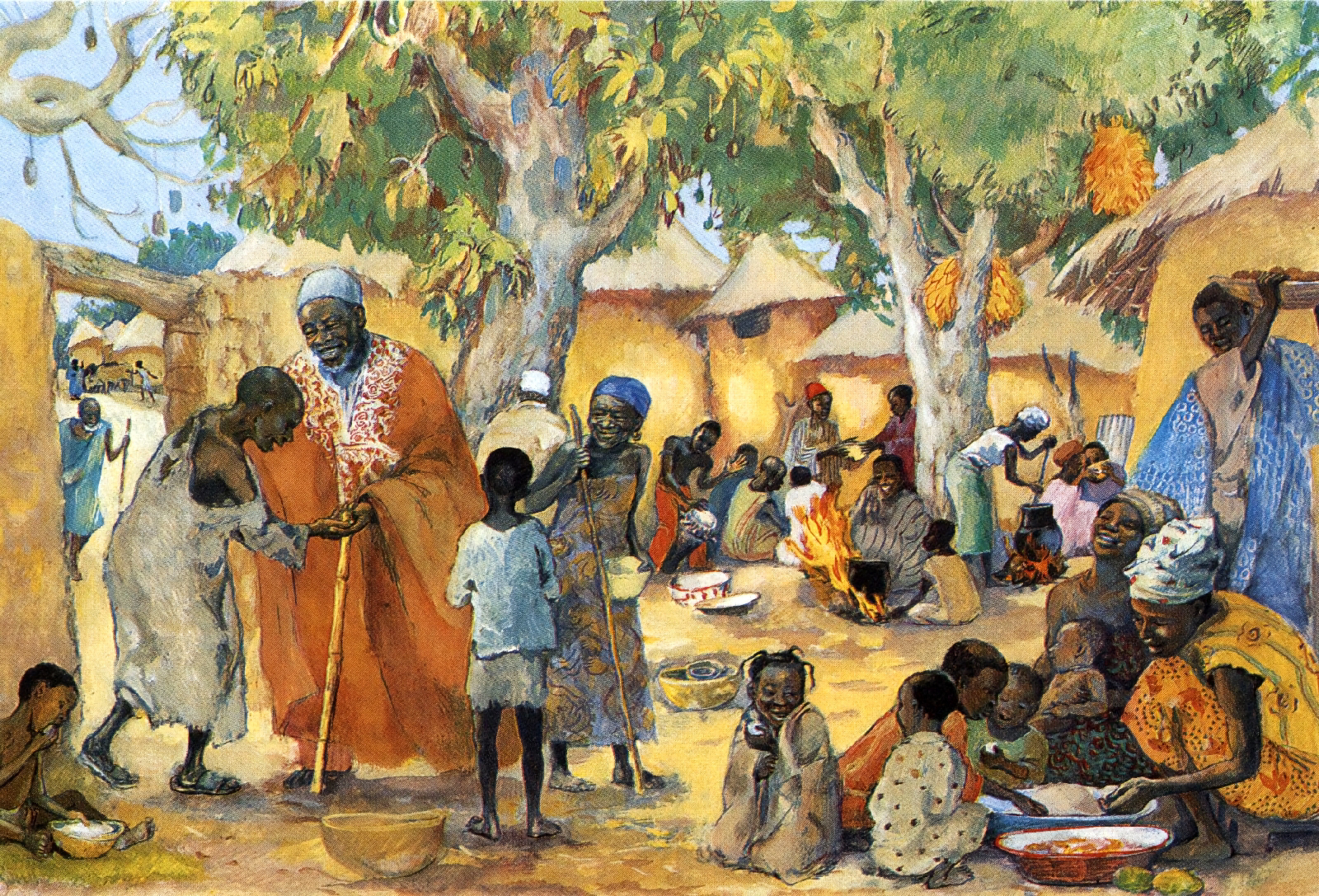
*art, "The Poor invited to the Feast," JESUS MAFA 1973 (from the vanderbilt divinity library digital archives).
Monday, January 20, 2025
Subscribe to:
Comments (Atom)


