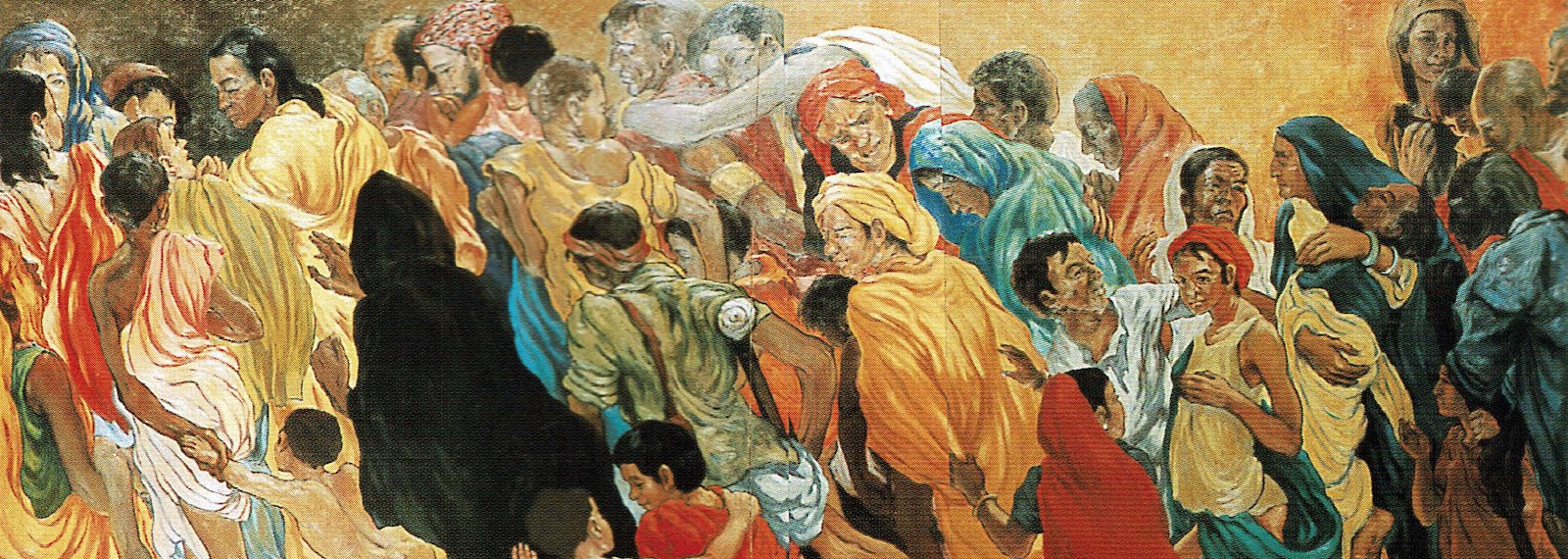
Saturday, June 17, 2023

Sodom and Gomorrah

Given the breadth and depth of the hurt, discrimination, and senseless deaths brought about by the homophobic reading of the sin of Sodom and Gomorrah, it is critical to go back to what Jesus said about the matter. And what other Biblical passages say. 

Sunday's lection has Jesus telling the disciples, "If anyone will not welcome you or listen to your words, shake off the dust from your feet as you leave that house or town. Truly I tell you, it will be more tolerable for the land of Sodom and Gomorrah on the day of judgment than for that town." 

The prophetic tradition describe what happened to Sodom and Gomorrah as God's judgment against the people's pride, excess of food, and prosperous ease while neglecting the poor, the needy, and strangers. 

One word: inhospitality. Over and over in the Bible, God calls God's people to always care for and to welcome widows, orphans, and strangers. Sodom and Gomorrah failed to do these. Many in Jesus's time failed as well.

Are we guilty of the real sin of Sodom and Gomorrah?

*art, "Sarah and Abraham offer hospitality to the Visitors," mosaic, Ravenna, Italy (from the vanderbilt divinity library digital archives). 

Thursday, June 08, 2023

THE GIFT OF TOUCH

Like many people I know, I was nurtured in a "touchy-feely" culture. Many of our pains-- physical or otherwise--were soothed and massaged away by the healing touch of our loved ones. Holding, hugging, and kissing were all integral parts of our growing up years. 

Many times, Vick's Vapor Rub was part of the ritual. "Haplos ng pagmamahal!" Touching helped in making us feel safe, loved, and not alone. We learned the science behind all these "touching moments" much later. 

Many of the healing narratives in the Gospels involve touching. Sunday's lection has two sections: the first part has a woman suffering for twelve years who touches Jesus's cloak; in the second part, Jesus touches a twelve-year old girl's hand and tells her to rise up.

Many of the quarantine protocols we've had to live with for three years were anti-poor because these assumed that everyone had a home to work from, that everyone had work, and that everyone had online access. 

Physical distancing has made so many socially distant. Alone. Depressed. Afraid. Ill. Desperate to touch someone or be touched. And experience healing. 

Friends, please let us go and help someone heal. Today. 


*art, "Woman with the Flow of Blood," Frank Wesley (1923-2002) available at vanderbilt divinity library archives.
**read "How to Hug During a Pandemic" (The New York Times) 

Thursday, June 01, 2023

IMMANUEL

William Carrey's 87-page pamphlet, "An Inquiry into the Obligation of Christians to Use Means for the Conversion of the Heathen," was an exposition of Matthew 28: 19-20. Published in 1792, it is considered as the first published work on the theology of missions. Centuries later, interpreters of the passage, which is Sunday's lection, still resonate with Carrey's exposition. Many missions dedicated to convert the "heathen" continue to be grounded on Carrey's exposition of "The Great Commission."


I have always argued that Immanuel, "God-with-Us," serves as the thread that binds the 28 chapters of the Gospel of Matthew. The Gospel, in 1.23, proclaims that Mary's son will be called Immanuel, meaning "God-with-Us" (echoing Isaiah 7.14). At the end of the Gospel, in 28. 20, Jesus proclaims, "I am with you always..." God-with-Us to the end of the age! The Gospel has one promise. We will never, ever, be alone.

One can ask, "What does it mean to experience Immanuel, to feel God's presence in our lives?" And, more often than not, the answer is, "Be God's presence in someone else's life!" Matthew's Jesus was.

Friends, our great commission is to do likewise. Do what Jesus did. Feed the hungry. Visit the prisoners. Welcome the stranger. Befriend the lonely. Let people know for sure that they are not alone, and then they will feel God's presence.

*art, "The Mission to the World," (JESUS MAFA, 1973, Cameroon), from the vanderbilt divinity library digital archives.

Thursday, May 25, 2023

PENTECOST

Many scholars agree that Sunday's lection contains John's version of the Pentecost. If the Acts' version happened 50 days after Jesus’s resurrection, John's happened on Easter evening.


I would like to share my take on verse 23.

Sin is legislated. Resistance is criminalized. Dissent is demonized. The merger of political and religious power predates Pontius Pilate's and Joseph Caiaphas's conjugal dictatorship.

If we read our Bibles and pray everyday, we will grow, grow, grow in this realization: sinners are, more often than not, synonymous with the poor, oppressed, and marginalized in the Gospels.

Who can afford the offerings in the temple and thus be cleansed of their sins? Who has the resources to bribe authorities and thus be declared not guilty? Who writes the law and for whose benefit?

Over and over in the Gospels, Jesus sins (against the Sabbath) and heals sinners. Over and over in the Gospels, Jesus declares sinners forgiven...to the consternation of the people who legislate sin.

In John 20:23, Jesus, after breathing on them to receive the Holy Spirit, commands his disciples to forgive and not to forgive. A better translation, echoing Matthew 16:19 and 18:18, is worded "to set free or to bind."

Jesus' command has not changed. Set free the poor. Bind the powerful who keep them poor. Friends, are you and I faithful to his command?

*art, "Pentecost," JESUS MAFA, 1973 (Cameroon), from the vanderbilt divinity library digital archives.

Friday, May 19, 2023

JESUS PRAYS FOR US

There are those among us who grew up in Christian communities that taught "all prayers need to end with 'in Jesus's name.'" There are those among us who grew up in churches that had regular prayer meetings and 24-hour prayer chains or prayer warriors. I am sure some of us have experienced falling asleep while we were praying.


Sunday's lection is part of what scholars call Jesus’s Farewell Discourse (chapters 14-17). Jesus knows he will be separated from his friends very soon. Imagine a line, a boundary, a threshold that Jesus had to cross, alone. A line his friends could not cross--not yet.

What does Jesus do? He prays for his friends. More importantly, he asks God to protect his friends. He asks God three times in his prayer.

I believe most of us read our Bibles and pray every day. Many of us pray several times a day. There are those among us who pray without ceasing. Oftentimes, our long prayers are often only about ourselves. There are also those who pray for those whose only hope is God. Then there are those, in these trying times, who need to cross lines, boundaries, and thresholds who need our prayers.

In all of these, we pray to Jesus. We ask. We beg. We cry. We are the ones praying.

Thus, many among us miss the point of our lection. Jesus is praying for his friends--not for himself. He prays for his loved ones when he, a man slated for execution by the state, has every reason to pray for himself!

In the midst of hopelessness and despair when we are most vulnerable and alone, Jesus lifts us in prayer. Good news indeed! JESUS. PRAYS. FOR. US!


*art, "The Ascension," JESUS MAFA, 1973 (Cameroon), from the vanderbilt divinity library digital archives.


Thursday, May 11, 2023

I WILL NOT LEAVE YOU ORPHANED

The infant mortality rate in the ancient world was 50%. Aristotle said that many of the babies who survived childbirth died before their seventh day! Many mothers died at childbirth so their children only survived because of wet nurses. Research has also shown that half of the population were fatherless by the time they reached 15 years of age.


Orphans were the most vulnerable people in the ancient world.

1 Esdras 3:19 and 4. 1-12 talk about the greatest contrasts in human life: free and slave, rich and poor, king and orphan. And the widest gap is in the contrast of the king and the orphan. The king was on top of the power structure, the ophan at the bottom. The king had absolute power, the ophan had none. Thus, in many ancient laws, the king is tasked to care for orphans. In the Hebrew Bible, God commits Godself to always care for orphans! In the Hebrew Bible, God reveals Godself as a wet nurse.

Jesus, in Sunday's lection, echoes the same commitment, "I will not leave you ophaned." He knew what being an orphan meant. I am sure most if not all his disciples were ophans as well.

Orphans remain one of the most vulnerable people today. Someone right now--alone, abandoned, afflicted--needs to hear Jesus's comforting words: "I will not leave you orphaned."

And who can they hear it from? A teacher. A pastor. A farmer. A no-longer distant relative. Just as the face of God can be on anybody's face, so too can the voice and compassion of a mother come from anybody.

*image, "Wet Nurse," (Roman Antiquity, from Google Zoeken, CTT0).


Friday, May 05, 2023

ROOMS FOR EVERYONE!

Sunday's lection provides an alternative vision to a world where displacement, dispossession, discrimination, and disenfranchisement occur on a daily basis, especially against the most vulnerable in our society.


We used to sing "Mansion Over the Hilltop" in church to affirm this alternative vision from the Gospel of John. Most modern Bible translations now use "rooms" or "dwelling places" instead of "mansions". (The New King James Version still uses "mansions".)

Sunday's alternative vision has at least three challenges for us who take pride in calling ourselves followers of the Risen One.

First, God's house has space--safe space--for everyone! All are welcome there. Second, Jesus will make sure everyone has a room. He will prepare each and every room. Finally, Jesus himself will welcome everyone to God's house! So that where he is, we will all be there also.

The vision is God's vision for the world God loves, not God's vision for heaven or anywhere else. The vision requires hard work. And we, my friends, you and I, are part of the realization of this vision.


*art, "All Are Welcome," book cover of the New York Times bestselling book by Alexandra Penfold and Suzanne Kaufman.

Thursday, April 27, 2023

THE SHEEP AND THEIR SHEPHERD

Many of us grew up with this passage from John 10. Many among us grew up with allegorical interpretations of this passage. The shepherd is not really a shepherd. The gatekeeper is really not a gatekeeper. The sheep are really not sheep. The thief and the bandit are not really thieves nor bandits.


Real sheep do know the voice of their shepherd. Sheep do follow their shepherd in and out of the sheepfold. Sheep do run away from those whose voice they do not know. Ask any shepherd.

Life in all its fullness is not inside the sheepfold. Never has been, never will be. No green grass. No fresh springs. All these are outside of it, in the wilderness. This is why the shepherd calls out the sheep by name and leads them out--into the wilderness. This is why the shepherd goes ahead of the sheep and they follow him--into the wilderness and into the quest for life. Life in all its fullness.

Friends, many times we forget that life in all its fullness is found outside the boxes we have created to contain it. Many times the life that really matters is waiting for us out in the wilderness. We just need to heed the voice of the Risen One who is already out there waiting for us.

*art, "The Good Shepherd," Julien Dupre (1851-1910), from the vanderbilt divinity library digital archives.  

Friday, April 21, 2023

THE RISEN ONE COMES AS A STRANGER

Who are the hungry, the thirsty, the naked, the sick, the unwelcomed, and the prisoner that Jesus challenges us to serve, to take sides with, and to love? The stranger.


Who are the widows, the orphans, the indigenous peoples, and the foreigners that, over and over, the Law and the Prophets enjoin us to care for, to hold dear, and to treat as sisters and brothers? The stranger.

Who are the daily wage earners, the laborers who survive from paycheck to paycheck, the homeless, the jobless, and the most vulnerable in a world ravaged by the pandemic that we are supposed to prioritize? Yes, the stranger.

If we read our Bibles and pray everyday, then we will grow in the realization that, most often than not, God comes as a stranger. God did when God shared the promise of Isaac's birth. God did when God judged the arrogance and inhospitality of Sodom and Gomorrah. God did when God wrestled with Jacob at Jabbok.

God came as a stranger when God was born in a manger instead of a palace; in Galilee instead of Jerusalem; among the odorized and the otherized; grew up in a mud hut instead of a white house.

God does as the Risen One: waiting for us to meet up in Galilee; reminding us that we will never be alone; calling the rich among us to sell everything we have, to give the proceeds to the poor, and to follow... In Sunday's lection, two disciples on the road to Emmaus encounter the Risen One as a complete stranger. Their eyes were eventually opened and their hearts strangely warmed when the stranger broke bread with them.

God always comes as a stranger. This is why we welcome the dispossessed, the displaced, the disenfranchised. This is why we open our homes, our churches, our spaces to Lumads, to People Living with HIV and AIDS, to refugees, to Palestinians, to those whose only hope is God.

God always comes as a stranger. This is why we always, always offer sanctuary. And these days, sanctuary can mean that extra room in our house, the available spaces in our church offices and buildings, the vacant rooms in our dormitories, and, yes, that extra bed. Safe spaces. Open hearts. Open minds. Open doors. Or five barley loaves and two fish.

*art, "Jesus appears at Emmaus," JESUS MAFA, 1973 (Cameroon), from the vanderbilt divinity library digital archives.

Saturday, April 15, 2023

THE RESURRECTION REQUIRES WARM BODIES

We love imagining the resurrected body. I have heard long discussions on how resurrected bodies are supposed to look, including what superhuman abilities these new bodies will have. Sometimes, our imagination gets the better of us.

Of this, I'm sure: despite their differences (and there are a lot), the four gospels all tell us that the Risen One has a body. In Sunday's lection from the Gospel of John, Jesus tells Thomas, "Put your finger here and see my hands. Reach out your hand and put it in my side." The Risen One has a body, and that resurrected body still bears the marks of the crucifixion. God knows who is responsible for each wound.

Every single day so many of our sisters and brothers--who serve the poor, the oppressed, and the marginalized--are red-tagged, abducted, tortured, brutalized, and crucified. Take heart! God knows. God remembers.

God will never forget the crucified. God will raise up each and every one of them. God always remembers the marks of each crucifixion. And God knows who is responsible for each of those wounds!

Dear Friends, then and now, the resurrection requires warm bodies that embody justice, solidarity, and life-giving. The resurrection requires warm bodies that will rise up for those who have fallen, that will continue the struggle for peace based on justice, and that will inspire more live-giving.

The resurrection always requires warm bodies. The resurrection requires your body. And mine.


*art, "Jesus appears to Thomas," JESUS MAFA (from vanderbilt divinity library digital archives).
*ganda!

Sunday, April 09, 2023

BLACK SATURDAY TOOK LONGER THAN 24 HOURS

That Jesus of Nazareth was executed via crucifixion by the Romans is a historical fact. That Jesus is Risen is a confession of faith. Those of us who went to seminary learned this early in our ministerial formation. John Dominic Crossan has argued that "Good" Friday brought about "Black" Saturday which eventually birthed the "Easter" Faith. And that Saturday was longer than 24 hours. Much, much longer.

Let me explain.

Students of the Bible will discover right away that the writers of the New Testament books have different interpretations of the Resurrection. And these interpretations did not come overnight.

Paul has several. First, appearances. The Risen Christ appears to his followers. Next, Jesus's resurrection as the first-fruits of the general resurrection. Third, the Church as the Body of the Risen Christ.

There are no appearances in Mark. Since almost all historians agree that the gospel ends in 16.8, what we have is a young man proclaiming that Jesus has been raised and is waiting in Galilee. In Matthew, Immanuel, the "I Am" is with his followers until the end of the age. In the Lukan narrative, the first book, the gospel is about Jesus. The second, the Acts of the Apostles, is about the Risen Christ working through the Spirit. In John, Jesus is alive whenever and wherever one offers one's life for a friend.

It is also fascinating to note that in the gospels, the announcement that Jesus has been raised come from a young man, two men, an angel, and even Jesus himself (in John). The number of women who came to the tomb vary, the only constant being Mary Magdalene. And in Luke and John's accounts, no one recognizes the Risen Christ when they first encounter him.

Why so many interpretations? Because diversity is the most important gift from God. But more importantly, the breadth and depth of God's grace and our experiences of that grace defy boundaries and borders.

Including time.


Saturday, April 08, 2023

LAST WORDS IN THE GOSPEL OF JOHN

Last words are very important to many of us. They provide closure.

Famous last words include: “Jesus, I love you,” by Mother Teresa; “It is very beautiful over there,” by Thomas Edison; “A life is like a garden. Perfect moments can be had, but not preserved, except in memory. LLAP [live long and prosper]!,”by Leonard Nimoy in his final tweet.

As of the end of March 2023, close to seven million people have died from COVID-19. Unfortunately, because of the protocols in 2020 and 2021, most of them--family, friends, colleagues--died alone, separated from us. Our last conversation, our last communication, our last text message--our last moments with them have taken on a more special meaning.

 Of course, the most famous last words ever recorded would be Jesus’ Last Words as found in the gospels: Mark has one. Matthew has one. Luke has three; and John has three. Many among us grew up with the traditional, harmonized version of Jesus's final words. “The Seven Last Words” as part of the church’s Lenten Tradition was started by Jesuits in Peru in the 17th. 

If we read our Bibles and pray every day, we will grow, grow, grow in the realization that the Gospel of John celebrates the discipleship of the unnamed.

In other words, the most faithful and effective followers of Jesus in the story have no names. The Samaritan woman by Jacob’s well, who engages Jesus in a dialogue of equals and runs to her people to share her experience with him, is unnamed. The young child who offers the five loaves and two fish so that Jesus can feed over five thousand people is also unnamed. The beloved disciple who plays a role bigger than Peter’s in the story is also unnamed. But most important of all, the only disciple who we find at the beginning and at the end of Jesus’s life is also unnamed: Jesus’s mother.

We find the two—Jesus’s mother and the beloved disciple—at the foot of the cross. Jesus says to them, “Woman behold your son; behold your mother.” Jesus asks that his two faithful disciples take care of each other. Love is the key theme of the Gospel of John. God became human because of love. The world is supposed to be blessed by our love for each other. Jesus in the Gospel of John leaves his followers only one commandment— greater love hath no one than this, that one offers one’s life for another. Mothers behold your sons; sons behold your mothers; parents behold your children; children behold your parents. We are members of the family of God and our primary task is to live in love for each other, like a family: each one willing to offer one’s life for the other. Each one willing to offer one’s life especially for those we do not consider our sisters and brothers or members of God’s family.

Then Jesus says, “I thirst.” Again, in the Johannine story, particularly in his conversation with the Samaritan woman, Jesus is the Living Water. Thus, many people find it puzzling that the one who says he is Living Water is suddenly thirsty. And he is given vinegar by his executioners.

 "I thirst” represents a quote from the Hebrew Bible--Psalm 69. Faith draws strength from the past. Like Daniel’s three friends who faced death yet believed in a God who will deliver them as God has delivered in the past, Jesus affirms the same unwavering faith in a deliverer God. And God did deliver Daniel’s three friends. And God delivered David (who wrote the Psalm). And Jesus believed God will deliver him, as well.

Then Jesus says, “It is finished.” The End. Jesus is dead: a victim of the horrors of torture, abuse, and state-sanctioned execution.

Remember the only commandment Jesus left his followers in the Gospel of John—greater love hath no one than this, that one offers one’s life for another? Jesus does exactly that. His life was an offering. And we are challenged to do the same. Jesus’s work is finished. Ours is not!  Jesus asked Peter three times if he loved Jesus… We are asked the same thing. Do we really love Jesus? Can we love as Jesus loved? His last words on the cross affirmed his faith in God, in people, in the transforming power of love and life, and empowered him to face a very violent death.

His last words on the cross affirmed a conviction that goodness will always conquer evil, that faith is stronger than fear, that hope is stronger than despair, that love is more powerful than indifference, and that life will always, always, conquer death.

My friends, last words are very important to us. They provide closure. Jesus’s last words serve as a challenge for us who are left behind to continue the work that God has begun. 

My hope is that they inspire us to dedicate our lives to bring about a future where God’s gift of resurrection will come without peoples and communities suffering the violence, the humiliation, and the torture of crucifixions. I pray you share this hope.


*art, "Cristo Nego," Martin Ruiz Anglada (1995) from the vanderbilt divinity library digital archives.


Thursday, March 30, 2023

TWO PARADES


Each year, on the last Monday of July, the President of the Philippines delivers a SONA (State of the Nation Address) before a joint session of Congress and the Senate.


Many among us have been part of the SONA--but on the streets, the PEOPLE'S SONA outside Congress, where the true state of the nation address is articulated by farmers, fisherfolk, laborers, migrants, Indigenous Peoples, and other marginalized sectors of society.

Historians tell us that each year during Passover, the Roman Occupation Forces in Palestine led by Pontius Pilate held a parade that featured
cavalry on horses, foot soldiers, leather armor, helmets, weapons, banners, golden eagles mounted on poles, sun glinting on metal and gold. It was a show of force, a reminder to everyone about the breadth and depth of Pax Romana, a threat to anyone who dreamed of liberation.

On one particular year--historians tell us--during Passover, another parade was held at the same time as Pilate's and his Legion. There, the true state of the Pax Romana, the Roman Peace was articulated by farmers, fisherfolk, laborers, migrants, Indigenous Peoples, and other marginalized sectors of society. This parade was led by a carpenter from Nazareth.

My friends, the world is full of parades, then and now. Many times, we are so easily seduced by parades that proclaim "Peace and Order" when our calling is to follow just one: the parade led by the carpenter from Nazareth; the one that is dedicated to "Peace based on Justice."

*art, "Entry into the City," John August Swanson (1990), from the vanderbilt divinity library digital archives.