Thursday, October 21, 2021

BARTIMAEUS

A fascinating thread that flows through Mark's narrative is the failure of the named disciples to understand the ministry of Jesus and the discipleship it requires. This failure is most pronounced in chapters 8,9,10, and 16. In 8,9,and 10 three times Jesus tells his disciples that he will be crucified and will be raised up. Three times his disciples do not believe him nor do they accept what he will do. Simon Peter actually rebukes him.


The male disciples fail Jesus first. The women disciples fail him next, in chapter 16. Don't forget that they went to the tomb expecting to anoint a dead body. No named disciples, male and female, believed Jesus in Mark. This is why the Gospel ends with women who are silent and afraid. Because the One they expected to find dead inside a locked tomb in Jerusalem was risen, in Galilee, and waiting for them!

In the Markan world of unbelief, we have Bartimaues, a named blind beggar, who does believe and follows Jesus. Twice he declares that Jesus is the Messiah (Son of David). Twice he cries out, "Kyrie eleison!" (Lord, have mercy). He calls Jesus, "My Teacher" and, after being healed, follows him.

Many times those of us who confess that we believe and follow Jesus ignore people on the wayside; people like Bartimaeus. Many times we tell them to shut up. Many times we pretend they are not there. Many times we turn our backs on them.

Many times they are actually the ones who do believe and follow Jesus. Because Jesus hears their cries when nobody else does.

#IAmWithJesus
#EndTheCultureOfImpunity
#StopTheKillingsPH
#FreePalestine
#JusticeForMyanmar
#StopTheKillingsPH

*art, "Jesus cures the man born blind," JESUS MAFA, 1973 (from the vanderbilt divinity library digital archives).

**One can also argue that Bartimaeus (Son of Timaeus) refers to Plato's Timaeus which discusses true sight as discerning the perfect world of "forms" as eternal and separate from the physical world. Mark might have been arguing that that true sight actually comes from following the Son of David, the perfect in physical form.

Thursday, October 14, 2021

RANSOM

Many people use this Sunday's lection to support the idea that Jesus paid the price for our sins. God is holy and humanity is sinful (and has tainted the whole of creation). The only way to appease God's righteousness is for God's sinless Son to die a horrible death on the cross for our sins.

There are also those who believe that Satan has all of us kidnapped and God pays for our ransom with the life of God's Son, Jesus.

The Greek term used for ransom in the passage denotes payment to release prisoners or liberate slaves which resonates with the promise of freedom in the Exodus and Jubilee narratives. Unlike the world's other Lords and Masters, Mark's Messiah serves instead of being served. He is ready to be last instead of being first. He does not have a throne with James on his right and John on his left. But he is crucified with rebels: one on his right, another on his left. He is ready to be a ransom to set prisoners and slaves free. He offers his body and his blood so that the hungry can eat and the thirsty can drink.

Simply put, he is willing to offer his life so that others may live. He chose to give his life, instead of doing it because God told him to. And he challenges those who follow him to do likewise.


#IAmWithJesus
#EndTheCultureOfImpunity
#StopTheKillingsPH
#FreePalestine
#JusticeForMyanmar

*image, "Black Liberation Theory" in Beyond the Classroom (from Saint Leo University Community).


Thursday, October 07, 2021

SELL EVERYTHING YOU HAVE!

Many rich people allegorize this Sunday's lection. For them "selling everything you have and giving all the proceeds to the poor" actually means something else. It is about putting God first in their lives. It is practicing "Christ above all". It means if you love God more than your money and you give regularly to charity, then it is okay to be rich. There are those who say it is not directed to the rich but to the super rich. My favorite is the interpretation that the message is exclusively for the rich young man in the passage. No one else's.

The pandemic has exposed the evils of the economies of death that run our world today. Close to 5 million people have died and tens of millions are jobless yet the richest 2,000 billionaires's wealth increased from 8 to over 12 trillion dollars! OXFAM reports if these people shared just 1/7 or about 14% of their income for 2020, they can eradicate world poverty! Thirty-five percent of the world's richest people are born rich, will never need to work one second in their lives, and will die richer! The United States of America has enough resources to feed 40 billion people! That's over 5 times the population of the world, yet ten thousand children starve to death every single day!
Do you know why there is a Second Coming?
Because we--those of us who call ourselves Christian whose cupboards are filled and do not need to pray "give us today our daily bread"--have failed miserably to do what Jesus commanded us during his First Coming. We have removed the "Poor" from the "Gospel to the Poor" that we are supposed to proclaim. We have not brought down the powerful from their thrones nor have we sent away the rich empty. Instead, we have embraced power, profit, and privilege. We have turned our backs on the One who called us to be salt, seed, and light and have, instead, connived with empire in order to rule the world.
We have failed to feed the hungry, to offer drink to the thirsty, to clothe the naked, to care for the sick, to visit the prisoners, and to welcome the stranger. We have forgotten that we are each other's keepers. We have been afraid to storm the halls of power to tell the rich and the super rich to sell everything they have and give all the proceeds to the poor because we have been complicit in legitimizing the systems, structures, and theologies that keep the rich richer and the poor miserable.
We have forgotten that the Earth is not inherited, but borrowed from our children--and when we are gone, these little ones who are first in the kingdom of heaven, will be the first to take the brunt of our mistakes.
We have ignored Jesus’s judgment in the second half of Sunday's lection: "It is easier for a camel to go through the eye of a needle than for someone who is rich to enter the kingdom of God."
*sculpture, "Educating the Rich on the Globe" by Tom Otterness (from the vanderbilt divinity library digital archives).

Thursday, September 30, 2021

JESUS ON DIVORCE


In many dominator societies, then and now, marriage provides an economic safety net for women. Divorced women could remarry to allow them the safety net marriage provided. Widows could also remarry for the same reason, levirate marriages being the best example.
In Sunday's lection from Mark 10, Jesus was asked about divorce by some married Pharisees who already knew the answer. They actually knew two answers to their question. (Yes to divorce because of the wife's adultery, and yes to divorce because of the wife's adultery and other things the husband finds objectionable about her.) Deuteronomy 24, which the Pharisees were alluding to, specifies that only husbands can divorce their wives.
Jesus, in a later conversation with the disciples, says wives can choose to divorce their husbands.
Choices play a primary role in this pericope. Divorce is a choice. The option started with Moses. Marriage is a choice, and is arguably the better choice for Jesus since this option has God's blessing. Unfortunately, many times, only the men get to choose either.
In the Philippines, there is no option to choose divorce because men in power decide which laws to pass. And they choose not to pass any law on divorce. They make the options that do exist-- annulment and legal separation-- costly and lengthy. They cover their ears to the cries of abused spouses-- especially wives-- and make a big show of using the law to protect the integrity of marriage and family. They forget that God knows how abusive spouses are themselves breaking apart what God made one.
I am sure that there are a lot of people who would disagree with Jesus's reasoning on this particular matter. I do. And it's perfectly okay. In Mark 12, a group of married Saduccees come to Jesus with a question about a woman who had to be married to seven husband's one after the other. I love Jesus's response in that episode.
In the end, no one, especially a man, has the right to take away a woman's autonomy and freedom to choose.

*art, "Jesus on Divorce, Remarriage, and Adultery," (Marg Mowczko).

Thursday, September 23, 2021

CUTTING OUR LIMBS OFF

Part of Sunday's lection has been used to scare children. Many grew up being told to cut off or pluck out body parts that cause them to sin. For a lot of young people, this meant at least three things: don't look at what will cause you to sin; don't touch what will cause you to sin; and don't go anywhere that will cause you to sin.


Three things. First, the passage is not for children. Second, there is no word for "sin" in the passage. Modern translations use "stumble" or "stumbling block". Better alternatives would be "snare" or "trap." Third, I believe the passage is addressed to a specific group of people: predators.

The first section of the passage is Jesus's judgment directed to those who take advantage of children, those who set snares and traps to exploit the little ones in God's kingdom, those who use, abuse, and reuse the anawim. Compared to the judgment coming to them, it would be better for them if great millstones were hung around their necks and they were thrown into the sea.

The second portion of the passage is a challenge directed to those who might still be saved from being thrown into the sea or being thrown into Gehenna+ where worms never die and the fire is never quenched. There is still hope as as long as they are prepared to enter life in the Kingdom of God maimed, lame, or one-eyed.

Many among us are not comfortable with an angry Jesus. Maybe we have been following the wrong Jesus.

#GodsReignIsForChildren
#IAmWithJesus
#FreePalestine
#JusticeForMyanmar
#StopTheKillingsPH
#EndTheCultureOfImpunity

*art, "The Angry Christ" (Alfonso Ossorio).
+Ancient traditions say that children were offered as burnt sacrifices at Gehenna. Recent archeological studies argue that it was used as a crematorium.

Thursday, September 16, 2021

THE GREATEST

Sunday's lection reminds me of Muhammad Ali. Today, people will not hesitate to describe him as "The Greatest," except maybe Floyd Mayweather. But there was a time in Ali's life when many treated him with hostility, disdain, and called him a "loud-mouthed nobody".

If you watch his fights in the 1960s, you can hear people booing him. Many came to his fights wanting to see him get a beating. His close friendship with Malcolm X, his decision to become a Moslem, and his being a conscientious objector against the Vietnam War made him one of the most hated men in America. Even to this day, people in power intentionally forget his contributions to the civil rights movement. Then there are those who still call him Cassius Clay, still binding him to the slave name of his ancestors.

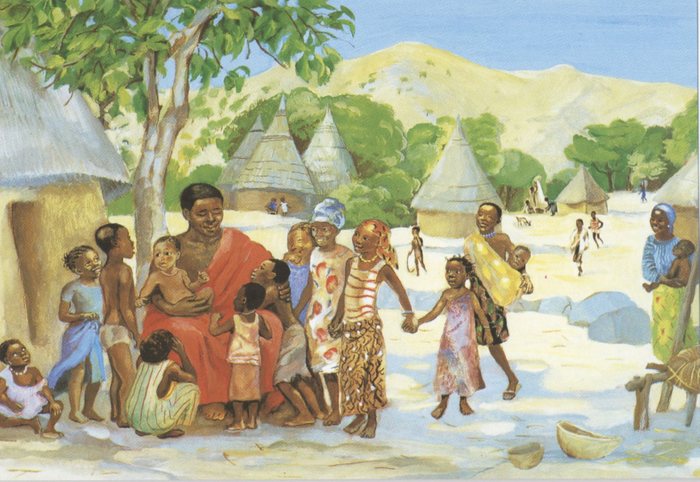
Sunday's lection reminds us about who are the greatest in the Kingdom of God: children. Not because they are playful. Not because they are forgiving. Not because they are innocent. But because then and now, despite our rhetoric to the contrary, the world treats them as nobodies.

The world spends more money on cosmetics, chocolate, ice cream, perfume, and pet food than on basic education and access to safe drinking water. Close to one billion children cannot read or write. Close to one billion children, mostly girls, spend up to 20 hours each day fetching water. Around ten thousand children starve to death every single day. Around half a million children die each year from diarrhea. Food is the solution to the first. Water, to the second. Our world has never been a child-friendly world.

So, what does it mean for us to proclaim that children are greatest in the Kingdom of God?


*art, "Jesus welcomes the children," JESUS MAFA collection (from the vanderbilt divinity library digital archives).
 

Thursday, September 09, 2021

WHO DO SAY I AM?

Close your eyes. Imagine Jesus. Is he handsome? With piercing blue eyes? With beautiful shoulder length hair? And is undeniably white?


In Sundays lection, the most definitely nondescript, most probably dark brown eyed, unkempt, and Palestinian Jesus asked his followers, "Who do people say I am?"

How did they respond? John the Baptist, Elijah, Jeremiah, or one of the Prophets. Do we associate "prophet" with Jesus, like our Moslem sisters and brothers do? One of the oldest historical traditions in the Hebrew Bible is about another prophet, Miriam. But many of us do not associate prophet with her as well. Sister of Moses, yes. But prophet? No.

Close your eyes. Imagine Jesus. Not your Personal Lord and Savior. Not the Prince of Peace nor the Lord of Lords. But Jesus of Nazareth, the Prophet. Like John, like Elijah, like Jeremiah, and, yes, like Miriam... Is he immersed with the struggles of the Palestinian people? Is he part of the Black Lives Matter movement? Is he in solidarity with farmers fighting for genuine agrarian reform?

Did he walk shoulder to shoulder with Kerima Lorena Tariman, Mon Ramirez, Randy Echanis, and Zara Alvarez in the quest for peace based on justice? Will he continue to speak truth to power and do much more?

Is he still calling us to follow him and, like him, take up the cross? Or have we been, all this time, following the wrong Jesus?

#EndTheCultureOfImpunity
#IAmWithJesus
#FreePalestine
#JunkTerrorLawNow
#JusticeForMyanmar
#StopTheKillingsPH
#COVID-19PH

*art, based on the work of Tom McElligott for the Episcopal Ad Project. Updated 2018 by Rev. Emmy Kegler.

Thursday, September 02, 2021

THE LITTLE BITCH WHO TAUGHT JESUS A LESSON. TAKE TWO.

In the Gospels of Matthew and Mark we find a story about a mother, a foreigner: a Syro-Phoenician in Mark; a Canaanite in Matthew who came to Jesus. Her little daughter was sick. She begged Jesus for help. She was initially ignored. She was even treated like a dog. Yet she persevered. And she persisted. And because she persevered, because she persisted, she got what she came for: her child was healed.

Robert Warrior, whose “Canaanites, Cowboys, and Indians” turned Hebrew Bible scholarship on its ear, argues that there might be something wrong with the Christian god, something requiring conversion and repentance. He notes that in the narrative, the “little bitch” does not become a follower of Jesus. She seeks him out because he has something she needs. She receives what she came for and walks away never to be mentioned again. She changes Jesus. Maybe she went back to her people and fought against the colonizing Romans in her own way with her own gods. The importance of her story is not whether she followed Jesus but that, without her, Jesus would have remained a narrow-minded bigot who viewed indigenous people as dogs.
The little bitch who taught Jesus a lesson was alone in the text. But in front of the text, she is not. She is Filipina. She is Palestinian. She is Mexican. She is Legion. She is transgressing borders. She is reclaiming what is hers. And she is fighting for her children’s lives, resisting empire, and surviving this pandemic her own way with her own gods.
*art, "The Canaanite Woman asks for healing for her daughter," Bazzi Rahib, Ilyas Basim Khuri (available at vanderbilt divinity library digital archives).

Thursday, August 26, 2021

HANDWASHING

Medical science linked the connections among handwashing, community health, and hygiene in the 19th century by observing discrepancies in mortality rates between two hospital wards. Of course, handwashing has always been part of diverse peoples' minimum community health protocols. Who among us remember our childhood when our elders repeatedly told us to wash our hands before meals, after using the toilet, when we come home from work?

The ritual described in Sunday's lection requires using a cup to wash each hand three times. It is a ritual that is founded on God's commandment-- being each other's keepers-- that has become something else by Jesus's time: a sign of division. When handwashing becomes nothing more than a sign that defines who are insiders and who are outsiders, who are pure and who are impure, who are clean and who are defiled, then we have a problem. Jesus calls it hypocrisy.

It is especially hypocritical and heartless, given that the people in Jesus's time who had access to clean water to begin with were also the ones who defined who was unclean, denied honor to the defiled, shut their doors to outsiders, and never lifted a finger to help them be clean.

The pandemic has killed over 4.4 million of our sisters and brothers. Handwashing-- and by extension-- wearing masks and physical distancing are concrete expressions of being each other's keepers. Every time we do these, we protect not only ourselves but everyone around us.

#CommunityPantryPH
#COVID-19PH
#IAmWithJesus
#EndTheCultureOfImpunity
#StopTheKillingsPH
#JusticeForMyanmar
#FreePalestine

*photograph from REUTERS.


Thursday, August 19, 2021

DO WE ALSO WISH TO GO AWAY?

Our Gospel lection readings for the past several weeks have been on John chapter 6. Sunday's lection asks a question that demands an answer from all of us: "Do you also wish to go away?"


Part of the passage reads: When many of his disciples heard it, they said, "This teaching is difficult; who can accept it?" But Jesus, being aware that his disciples were complaining about it, said to them, "Does this offend you?" Because of this, many of his disciples turned back and no longer went about with him. So Jesus asked the twelve, "Do you also wish to go away?"

Many among us grew up with Sunday School images of Jesus surrounded by masses of people. Many among us grew up believing that if Jesus were around, he'll be more popular than the Pope or Michael Jackson. Many among us think that if Jesus were elected US President, peace based on justice will reign.

There are those among us who believe that Jesus is the answer; that he is the solution to our problems; and that he will right all wrongs when he returns.

But the Gospel of John paints a different picture. Following Jesus is really hard. Following Jesus requires making very difficult decisions. Folllowing Jesus demands offering one's life for another.

By John chapter 6, Jesus had only the Twelve left. By the time of his arrest, there were only two left from the Twelve. At his crucifixion, only the Beloved Disciple was left.

You and I, are we here to stay? Are we committed to the highest calling of the Gospel? Or, like so many others, do we also wish to go away?

In the name of our God, creator, redeemer, and friend. Amen.

#IAmWithJesus
#EndTheCultureOfImpunity
#StopTheKillingsPH
#JusticeForMyanmar
#FreePalestine

Thursday, August 12, 2021

WE ARE WHAT WE EAT

Sunday’s lection from John is about eating Jesus’s flesh and drinking his blood. This passage has been interpreted in so many different ways throughout the centuries. It serves as a basis for the Roman Catholic church’s doctrine of transubstantiation. Others call this John’s version of the Last Supper or Eucharistic ritual found in the latter part of the Synoptic Gospels. Others locate this as a part of the “I Am” discourses of the Johannine Jesus.


The Gospel declares, the Word became flesh and dwelt among us. God became human. In the fullness of time, God decided to become one of us. Oftentimes we say that the Gospel of John is the most spiritual of the gospels. It is, since spirit (which is ruach in Hebrew, pneuma in Greek, and anima in Latin) actually means breath. “Hininga." Simply put, spirit is oxygen for people and carbon dioxide for plants. Spirit, in other words, is matter. Spirit has molecules. Thus, the Gospel of John abounds with powerful metaphors which are material, physical, and earthy: water; bread and fish; shepherds, sheep, and lambs; tears and death; wombs, births, and rebirths. Now, we are commanded to eat the Word made flesh and drink his blood. And we will live.

There are people whose daily lives revolve around coffee. There are those who cannot function well without rice. Then, there are those who share an intimate relationship with pan de sal and Reno liver spread, with mami and siopao, with San Miguel Beer and adobo peanuts. Finally, there are those who are addicted to Jesus.

Loving, craving, eating Jesus on a daily basis, like manna, is dangerous. It is life-changing, transformative, and very, very risky! It requires giving up one’s life for another.

It means eventually becoming what you eat, being like Jesus—love in the flesh, food for the hungry, drink for the thirsty, clothing for the naked, a friend to the stranger and the sick, freedom to the captives, salt of the earth, light in the darkness, bread for the world.

To offer one’s “flesh and blood” is to offer the whole self. Jesus did. This is the path to abundant life for all. Self-giving. Offering “flesh and blood” so that others may live. Jesus said, “No one has greater love than this, to lay down one’s life for one’s friends.” And he did. And we are invited to do the same.

Sisters and brothers, people say, we are what we eat. For those of us who call ourselves friends of Jesus, I pray we really are!

#IAmWithJesus
#EndTheCultureOfImpunity
#StopTheKillingsPH
#FreePalestine
#JusticeForMyanmar

*art, "Bread and Fish," catacomb, 3rd century (from vanderbilt divinity library archives).

Friday, August 06, 2021

CARPE DIEM

My favorite lines in the movie Kung Fu Panda go, "Yesterday is history. Tomorrow is a mystery. Today is a gift, that's why we call it present." Unfortunately, research shows that many people spend up to 50% of their time regretting the past and 40% worrying about the future. That leaves 10% for the gift we call present.


I think this is why the "I Am" statements in John, including Sunday's lection, are important. Jesus did not say, "I was" nor did he say "I will be." Carpe diem. Jesus seized the moment!

Many times in our lives we are left immobile: trapped between what we could have done better and what we could do better instead of seizing the moment, the now. Because the hungry need bread right now. The thirsty need drink right now. So many of our sisters and brothers need help right now.

You are; I am; we are each other's keepers. Now.

#COVID-19PH
#CommunityPantryPH
#IAmWithJesus
#JusticeForMyanmar
#FreePalestine
#EndTheCultureOfImpunity

*image, "Artoklasia or Breaking of Bread Service (Greek Orthodox Church), from Vanderbilt Divinity Library digital archives.