Part of Sunday's lection has been used to scare children. Many grew up being told to cut off or pluck out body parts that cause them to sin. For a lot of young people, this meant at least three things: don't look at what will cause you to sin; don't touch what will cause you to sin; and don't go anywhere that will cause you to sin.
Three things. First, the passage is not for children. Second, there is no word for "sin" in the passage. Modern translations use "stumble" or "stumbling block". Better alternatives would be "snare" or "trap." Third, I believe the passage is addressed to a specific group of people: predators.
The first section of the passage is Jesus's judgment directed to those who take advantage of children, those who set snares and traps to exploit the little ones in God's kingdom, those who use, abuse, and reuse the anawim. Compared to the judgment coming to them, it would be better for them if great millstones were hung around their necks and they were thrown into the sea.
The second portion of the passage is a challenge directed to those who might still be saved from being thrown into the sea or being thrown into Gehenna+ where worms never die and the fire is never quenched. There is still hope as as long as they are prepared to enter life in the Kingdom of God maimed, lame, or one-eyed.
Many among us are not comfortable with an angry Jesus. Maybe we have been following the wrong Jesus.
#GodsReignIsForChildren
#IAmWithJesus
#FreePalestine
#JusticeForMyanmar
#StopTheKillingsPH
#EndTheCultureOfImpunity
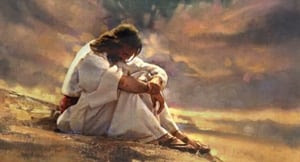
*art, "The Angry Christ" (Alfonso Ossorio).
+Ancient traditions say that children were offered as burnt sacrifices at Gehenna. Recent archeological studies argue that it was used as a crematorium.
READING THE BIBLE INSIDE A JEEPNEY: Celebrating Colonized and Occupied Peoples' capacity to beat swords into plowshares; to transform weapons of mass destruction into instruments of mass celebration; mortar shells into church bells, teargas canisters to flowerpots; rifle barrels into flutes; U.S. Military Army Jeeps into Filipino Mass Transport Jeepneys.
Thursday, September 23, 2021
Thursday, September 16, 2021
THE GREATEST
Sunday's lection reminds me of Muhammad Ali. Today, people will not hesitate to describe him as "The Greatest," except maybe Floyd Mayweather. But there was a time in Ali's life when many treated him with hostility, disdain, and called him a "loud-mouthed nobody".
If you watch his fights in the 1960s, you can hear people booing him. Many came to his fights wanting to see him get a beating. His close friendship with Malcolm X, his decision to become a Moslem, and his being a conscientious objector against the Vietnam War made him one of the most hated men in America. Even to this day, people in power intentionally forget his contributions to the civil rights movement. Then there are those who still call him Cassius Clay, still binding him to the slave name of his ancestors.
Sunday's lection reminds us about who are the greatest in the Kingdom of God: children. Not because they are playful. Not because they are forgiving. Not because they are innocent. But because then and now, despite our rhetoric to the contrary, the world treats them as nobodies.
The world spends more money on cosmetics, chocolate, ice cream, perfume, and pet food than on basic education and access to safe drinking water. Close to one billion children cannot read or write. Close to one billion children, mostly girls, spend up to 20 hours each day fetching water. Around ten thousand children starve to death every single day. Around half a million children die each year from diarrhea. Food is the solution to the first. Water, to the second. Our world has never been a child-friendly world.
So, what does it mean for us to proclaim that children are greatest in the Kingdom of God?
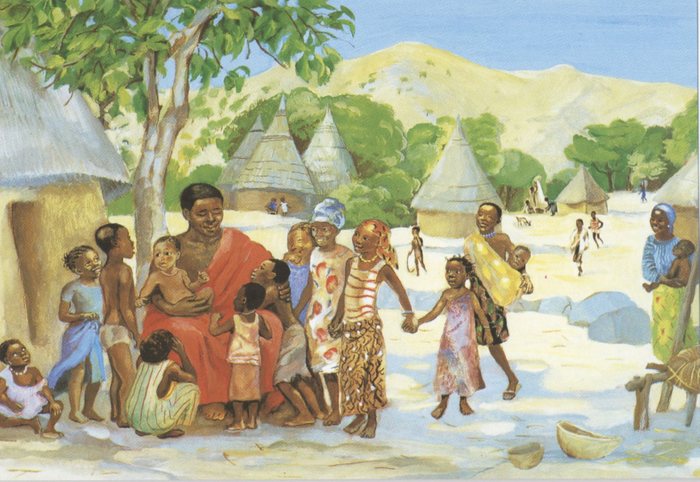
*art, "Jesus welcomes the children," JESUS MAFA collection (from the vanderbilt divinity library digital archives).
If you watch his fights in the 1960s, you can hear people booing him. Many came to his fights wanting to see him get a beating. His close friendship with Malcolm X, his decision to become a Moslem, and his being a conscientious objector against the Vietnam War made him one of the most hated men in America. Even to this day, people in power intentionally forget his contributions to the civil rights movement. Then there are those who still call him Cassius Clay, still binding him to the slave name of his ancestors.
Sunday's lection reminds us about who are the greatest in the Kingdom of God: children. Not because they are playful. Not because they are forgiving. Not because they are innocent. But because then and now, despite our rhetoric to the contrary, the world treats them as nobodies.
The world spends more money on cosmetics, chocolate, ice cream, perfume, and pet food than on basic education and access to safe drinking water. Close to one billion children cannot read or write. Close to one billion children, mostly girls, spend up to 20 hours each day fetching water. Around ten thousand children starve to death every single day. Around half a million children die each year from diarrhea. Food is the solution to the first. Water, to the second. Our world has never been a child-friendly world.
So, what does it mean for us to proclaim that children are greatest in the Kingdom of God?
*art, "Jesus welcomes the children," JESUS MAFA collection (from the vanderbilt divinity library digital archives).
Thursday, September 09, 2021
WHO DO SAY I AM?
Close your eyes. Imagine Jesus. Is he handsome? With piercing blue eyes? With beautiful shoulder length hair? And is undeniably white?
In Sundays lection, the most definitely nondescript, most probably dark brown eyed, unkempt, and Palestinian Jesus asked his followers, "Who do people say I am?"
How did they respond? John the Baptist, Elijah, Jeremiah, or one of the Prophets. Do we associate "prophet" with Jesus, like our Moslem sisters and brothers do? One of the oldest historical traditions in the Hebrew Bible is about another prophet, Miriam. But many of us do not associate prophet with her as well. Sister of Moses, yes. But prophet? No.
Close your eyes. Imagine Jesus. Not your Personal Lord and Savior. Not the Prince of Peace nor the Lord of Lords. But Jesus of Nazareth, the Prophet. Like John, like Elijah, like Jeremiah, and, yes, like Miriam... Is he immersed with the struggles of the Palestinian people? Is he part of the Black Lives Matter movement? Is he in solidarity with farmers fighting for genuine agrarian reform?
Did he walk shoulder to shoulder with Kerima Lorena Tariman, Mon Ramirez, Randy Echanis, and Zara Alvarez in the quest for peace based on justice? Will he continue to speak truth to power and do much more?
Is he still calling us to follow him and, like him, take up the cross? Or have we been, all this time, following the wrong Jesus?
#EndTheCultureOfImpunity
#IAmWithJesus
#FreePalestine
#JunkTerrorLawNow
#JusticeForMyanmar
#StopTheKillingsPH
#COVID-19PH
*art, based on the work of Tom McElligott for the Episcopal Ad Project. Updated 2018 by Rev. Emmy Kegler.
Thursday, September 02, 2021
THE LITTLE BITCH WHO TAUGHT JESUS A LESSON. TAKE TWO.
In the Gospels of Matthew and Mark we find a story about a mother, a foreigner: a Syro-Phoenician in Mark; a Canaanite in Matthew who came to Jesus. Her little daughter was sick. She begged Jesus for help. She was initially ignored. She was even treated like a dog. Yet she persevered. And she persisted. And because she persevered, because she persisted, she got what she came for: her child was healed.
Robert Warrior, whose “Canaanites, Cowboys, and Indians” turned Hebrew Bible scholarship on its ear, argues that there might be something wrong with the Christian god, something requiring conversion and repentance. He notes that in the narrative, the “little bitch” does not become a follower of Jesus. She seeks him out because he has something she needs. She receives what she came for and walks away never to be mentioned again. She changes Jesus. Maybe she went back to her people and fought against the colonizing Romans in her own way with her own gods. The importance of her story is not whether she followed Jesus but that, without her, Jesus would have remained a narrow-minded bigot who viewed indigenous people as dogs.
The little bitch who taught Jesus a lesson was alone in the text. But in front of the text, she is not. She is Filipina. She is Palestinian. She is Mexican. She is Legion. She is transgressing borders. She is reclaiming what is hers. And she is fighting for her children’s lives, resisting empire, and surviving this pandemic her own way with her own gods.
*art, "The Canaanite Woman asks for healing for her daughter," Bazzi Rahib, Ilyas Basim Khuri (available at vanderbilt divinity library digital archives).
Thursday, August 26, 2021
HANDWASHING
Medical science linked the connections among handwashing, community health, and hygiene in the 19th century by observing discrepancies in mortality rates between two hospital wards. Of course, handwashing has always been part of diverse peoples' minimum community health protocols. Who among us remember our childhood when our elders repeatedly told us to wash our hands before meals, after using the toilet, when we come home from work?
The ritual described in Sunday's lection requires using a cup to wash each hand three times. It is a ritual that is founded on God's commandment-- being each other's keepers-- that has become something else by Jesus's time: a sign of division. When handwashing becomes nothing more than a sign that defines who are insiders and who are outsiders, who are pure and who are impure, who are clean and who are defiled, then we have a problem. Jesus calls it hypocrisy.
It is especially hypocritical and heartless, given that the people in Jesus's time who had access to clean water to begin with were also the ones who defined who was unclean, denied honor to the defiled, shut their doors to outsiders, and never lifted a finger to help them be clean.
The pandemic has killed over 4.4 million of our sisters and brothers. Handwashing-- and by extension-- wearing masks and physical distancing are concrete expressions of being each other's keepers. Every time we do these, we protect not only ourselves but everyone around us.
#CommunityPantryPH
#COVID-19PH
#IAmWithJesus
#EndTheCultureOfImpunity
#StopTheKillingsPH
#JusticeForMyanmar
#FreePalestine
*photograph from REUTERS.
The ritual described in Sunday's lection requires using a cup to wash each hand three times. It is a ritual that is founded on God's commandment-- being each other's keepers-- that has become something else by Jesus's time: a sign of division. When handwashing becomes nothing more than a sign that defines who are insiders and who are outsiders, who are pure and who are impure, who are clean and who are defiled, then we have a problem. Jesus calls it hypocrisy.
It is especially hypocritical and heartless, given that the people in Jesus's time who had access to clean water to begin with were also the ones who defined who was unclean, denied honor to the defiled, shut their doors to outsiders, and never lifted a finger to help them be clean.
The pandemic has killed over 4.4 million of our sisters and brothers. Handwashing-- and by extension-- wearing masks and physical distancing are concrete expressions of being each other's keepers. Every time we do these, we protect not only ourselves but everyone around us.
#CommunityPantryPH
#COVID-19PH
#IAmWithJesus
#EndTheCultureOfImpunity
#StopTheKillingsPH
#JusticeForMyanmar
#FreePalestine
*photograph from REUTERS.
Thursday, August 19, 2021
DO WE ALSO WISH TO GO AWAY?
Our Gospel lection readings for the past several weeks have been on John chapter 6. Sunday's lection asks a question that demands an answer from all of us: "Do you also wish to go away?"
Part of the passage reads: When many of his disciples heard it, they said, "This teaching is difficult; who can accept it?" But Jesus, being aware that his disciples were complaining about it, said to them, "Does this offend you?" Because of this, many of his disciples turned back and no longer went about with him. So Jesus asked the twelve, "Do you also wish to go away?"
Many among us grew up with Sunday School images of Jesus surrounded by masses of people. Many among us grew up believing that if Jesus were around, he'll be more popular than the Pope or Michael Jackson. Many among us think that if Jesus were elected US President, peace based on justice will reign.
There are those among us who believe that Jesus is the answer; that he is the solution to our problems; and that he will right all wrongs when he returns.
But the Gospel of John paints a different picture. Following Jesus is really hard. Following Jesus requires making very difficult decisions. Folllowing Jesus demands offering one's life for another.
By John chapter 6, Jesus had only the Twelve left. By the time of his arrest, there were only two left from the Twelve. At his crucifixion, only the Beloved Disciple was left.
You and I, are we here to stay? Are we committed to the highest calling of the Gospel? Or, like so many others, do we also wish to go away?
In the name of our God, creator, redeemer, and friend. Amen.
#IAmWithJesus
#EndTheCultureOfImpunity
#StopTheKillingsPH
#JusticeForMyanmar
#FreePalestine
Thursday, August 12, 2021
WE ARE WHAT WE EAT
Sunday’s lection from John is about eating Jesus’s flesh and drinking his blood. This passage has been interpreted in so many different ways throughout the centuries. It serves as a basis for the Roman Catholic church’s doctrine of transubstantiation. Others call this John’s version of the Last Supper or Eucharistic ritual found in the latter part of the Synoptic Gospels. Others locate this as a part of the “I Am” discourses of the Johannine Jesus.
The Gospel declares, the Word became flesh and dwelt among us. God became human. In the fullness of time, God decided to become one of us. Oftentimes we say that the Gospel of John is the most spiritual of the gospels. It is, since spirit (which is ruach in Hebrew, pneuma in Greek, and anima in Latin) actually means breath. “Hininga." Simply put, spirit is oxygen for people and carbon dioxide for plants. Spirit, in other words, is matter. Spirit has molecules. Thus, the Gospel of John abounds with powerful metaphors which are material, physical, and earthy: water; bread and fish; shepherds, sheep, and lambs; tears and death; wombs, births, and rebirths. Now, we are commanded to eat the Word made flesh and drink his blood. And we will live.
There are people whose daily lives revolve around coffee. There are those who cannot function well without rice. Then, there are those who share an intimate relationship with pan de sal and Reno liver spread, with mami and siopao, with San Miguel Beer and adobo peanuts. Finally, there are those who are addicted to Jesus.
Loving, craving, eating Jesus on a daily basis, like manna, is dangerous. It is life-changing, transformative, and very, very risky! It requires giving up one’s life for another.
It means eventually becoming what you eat, being like Jesus—love in the flesh, food for the hungry, drink for the thirsty, clothing for the naked, a friend to the stranger and the sick, freedom to the captives, salt of the earth, light in the darkness, bread for the world.
To offer one’s “flesh and blood” is to offer the whole self. Jesus did. This is the path to abundant life for all. Self-giving. Offering “flesh and blood” so that others may live. Jesus said, “No one has greater love than this, to lay down one’s life for one’s friends.” And he did. And we are invited to do the same.
Sisters and brothers, people say, we are what we eat. For those of us who call ourselves friends of Jesus, I pray we really are!
#IAmWithJesus
#EndTheCultureOfImpunity
#StopTheKillingsPH
#FreePalestine
#JusticeForMyanmar
*art, "Bread and Fish," catacomb, 3rd century (from vanderbilt divinity library archives).
Friday, August 06, 2021
CARPE DIEM
My favorite lines in the movie Kung Fu Panda go, "Yesterday is history. Tomorrow is a mystery. Today is a gift, that's why we call it present." Unfortunately, research shows that many people spend up to 50% of their time regretting the past and 40% worrying about the future. That leaves 10% for the gift we call present.
I think this is why the "I Am" statements in John, including Sunday's lection, are important. Jesus did not say, "I was" nor did he say "I will be." Carpe diem. Jesus seized the moment!
Many times in our lives we are left immobile: trapped between what we could have done better and what we could do better instead of seizing the moment, the now. Because the hungry need bread right now. The thirsty need drink right now. So many of our sisters and brothers need help right now.
You are; I am; we are each other's keepers. Now.
#COVID-19PH
#CommunityPantryPH
#IAmWithJesus
#JusticeForMyanmar
#FreePalestine
#EndTheCultureOfImpunity
*image, "Artoklasia or Breaking of Bread Service (Greek Orthodox Church), from Vanderbilt Divinity Library digital archives.
Thursday, July 29, 2021
WE ARE THE ANSWER. NOW!
There is a virus that has killed more people than any pandemic. It is hunger. And the vaccine has always been available. It is food. Historians tell us that up to half of the population during Jesus’s time was slowly starving to death. This deadly virus only affects the poor. The rich are immune to it.
Last Sunday's lection reminded us that one poor and hungry child's offering was the beginning of the feeding of the 5000 poor and hungry people.
This Sunday's lection reminds us not to focus on the manna, nor on the bread and fish, but on the source of the offering: The poor child; God; and Jesus who says, "I Am the Bread of Life."
My friends, it is time we realize that, like the child with five barley loaves and two fish, we are the answer to Jesus’s plea. And gifts we can offer today, right now, are more life-giving than the ones we plan to give tomorrow.
We often forget that we play the primary role in the realization of our dreams, that we are the change that we desperately need, that we are the answer to many of our prayers, and that tomorrow is already here, since today is the tomorrow we hoped for yesterday!
#IAmWithJesus
#CommunityPantryPH
#EndTheCultureOfImpunity
#StopTheKillingsPH
#FreePalestine
#JusticeForMyanmar
*photograph, "Bread of Life," (from vanderbilt divinity library digital archives)
Thursday, July 22, 2021
THE PARABLE OF FIVE BARLEY LOAVES AND TWO FISH
There are many people who imagine this story-- which we find in all four canonical gospels-- as an actual event in Jesus's ministry. There are those who argue that it is a parable. All the parables we have looked at so far are stories that Jesus told. This one is different. It's a parable from the early church. Jesus is a character in the parable.
He sees the multitude hungry and, following the teachings of the Law and the Prophets, he tells his disciples to feed them. In the Synoptics, his disciples make up excuses. Send the crowd away. Let them feed themselves. In Sunday's lection from John 6, they tell him: we don't have enough funds to address the situation.
The excuses then sound so much like our excuses today.
Then a young child, possibly 12 years old or younger, offers what he has. Five barley loaves and two fish. And the miracle of feeding of the 5000 begins. There is a tradition that says barley tastes good... to cows, sheep, and horses! The poor, the anawim, ate barley. It was all they could afford. The rich had storehouses of wheat, and fattened themselves with it.
Do not forget this. Ever. The barley loaves and the fish that led to the feeding of the HUNGRY multitudes were offered by a POOR, HUNGRY child. Many times, God's liberating acts begin when one-- just one we usually do not expect-- takes that step forward, that leap of faith, that offering of bread and fish.
#IAmWithJesus
#EndTheCultureOfImpunity
#StopTheKillingsPH
#JusticeForMyanmar
#FreePalestine
*art, "Jesus multiplies the loaves and fish," (JESUS MAFA) from vanderbilt divinity library digital archives.
Thursday, July 15, 2021
DAY OFF
One of the more fascinating characteristics of God in Genesis 1 is one many of us miss. God rests on the seventh day.
In other words, God takes a day off.
Sunday's lection offers us a glimpse of Jesus declaring a break for himself and his discples. Mark 6:31 reads: Then, because so many people were coming and going that they did not even have a chance to eat, he said to them, “Come with me by yourselves to a quiet place and get some rest.”
They did go away to a quiet place and got some rest.
My friends, almost everyone needs a break. I say "almost everyone," because there are people who are born wealthy and who will die wealthier without ever working one minute of their entire lives. This post is not about them.
There are Church Workers whose official day off falls on Mondays. But they have never, ever, had a single day off. Even the land needs a Sabbath. And so does Mother Earth.
On July 19, Monday, please take the day off.
#IAmWithJesus
#EndTheCultureOfImpunity
#StopTheKillingsPH
#FreePalestine
#JusticeForMyanmar
#JunkTerrorLawNow
*art, "take no cloak or sandals," from readingacts.
Friday, July 09, 2021
SALOME AND KAKAY
Kakay Pamaran's work on Salome is a brilliant thesis using Historical Jesus Research methods. She argues that the "princess's dance which led to the prophet's death" tradition is part of a much bigger extra-canonical Salome Corpus that is still waiting to be collected, catalogued, and celebrated.
Salome and Mary Magdalene are two of the most attested interlocutors of Jesus in extra-canonical Christian literature. There are scholars whose research have shown how Mary Magdalene has been systematically erased from orthodox traditions. Kakay's research pursues a similar trajectory. There are copies of Mark where Salome completely disappears from the list of the women who discovers the empty tomb. Matthew’s and Luke's accounts do not mention Salome.
Many people today would call Magdalene a prostitute or adulteress and Salome a temptress or seductress. All these are false. Fake news. Kakay's work calls the church to repent of its violent sins of systematic erasuring and institutional forgetting.
More importantly, Kakay's work challenges the church to open the canon and discover the diverse, pluriform, and multivocal Christian traditions that make up the 99% that orthodoxy have marginalized.
*Kakay Pamaran, Salvae Salome: Corpus, Myth, Canon, and the Quest for Salome (Union Theological Seminary, Philippines Master of Theology thesis, 2021).
Thursday, July 01, 2021
HOMECOMING
Homecomings conjure up positive images for a lot of people, especially these days. For many, homecoming is almost synonymous with reunion--especially during these trying days.
We can touch again. We can hug again. We can play again. We can talk in person again. We do not have to worry as much about infecting each other with unknown illnesses. This is the homecoming, the reunion most of us picture.
But Sunday's lection on Jesus's homecoming paints a different picture. His townmates ask, "Is not this the carpenter, the son of Mary and brother of James and Joses and Judas and Simon, and are not his sisters here with us?" Mark's 'The carpenter from Nazareth, the son of Mary' (read, bastard) was a hard sell. It was certainly a hard sell for the other Nazarenes; in the Lukan version of this story, they tried to throw Jesus off a cliff.
I always ask my students to imagine a daughter or sister or friend who is barely out of her teens being pregnant and telling everyone that the father of her child is the Holy Spirit. Mark's 'The carpenter from Nazareth, the son of Mary' (read, bastard) was a hard sell. Then and now.
To this day, the bastard from Nazareth who lived his life with and for those whose only hope was God; who preached good news to the poor; who challenged the rich to sell everything they have and give the proceeds to the destitute; who defied empire and its life-negating systems; and who commanded everyone who followed him to offer one's life for a friend; remains a very hard sell.
You can't exactly sell a way of life that carries a high risk of being executed by the state, can you?
#IAmWithJesus
#EndTheCultureOfImpunity
#StopTheKillingsPH
#FreePalestine
#JusticeForMyanmar
*art, "Jesus as a child in Nazareth," (JESUS MAFA) available at the Vanderbilt Divinity Library digital archives.
Subscribe to:
Comments (Atom)